
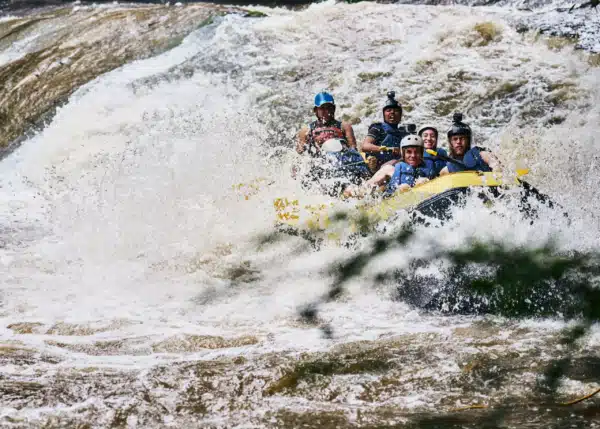
Master the Maw: Critical Skills for Running Holes on the Ocoee River
The Ocoee River isn’t just a stretch of water; it’s a living, breathing obstacle course. For those who have felt the spray of “Broken Nose” or the surge of “Double Trouble,” you know that the most intimidating features on the river aren’t just the rocks—it’s the holes. Often referred to as hydraulics or reversals, holes are where the river’s power is most concentrated, and mastering them is the difference between a clean run and an accidental swim.
At Outland Expeditions, we believe that the best rafter is an informed rafter. Whether you’re a first-timer or a whitewater veteran, understanding the mechanics of a river hole and the skills required to navigate them will transform your Ocoee experience from a wild ride into a calculated victory.
What exactly is a “hole” in whitewater rafting?
In the simplest terms, a hole is a river feature formed when water flows over a submerged rock or ledge. As the water drops off the back of the obstacle, it creates a depression. The surrounding water then rushes back upstream to fill that space, creating a recirculating current of aerated, frothy “white” water.
On the Ocoee, holes vary in personality. Some are “friendly” and will simply give you a good splash as you pass through. Others are “sticky,” meaning their recirculating current is strong enough to hold a raft in place, making it “surf” or even flip if not handled correctly. Understanding that the water inside a hole is actually moving back toward the drop is the first step in learning how to beat it.
Why is momentum the most important tool for running holes?
If you take away only one piece of advice for your trip with Outland Expeditions, let it be this: Speed is your friend. When a raft enters a hole, the recirculating water is trying to push the boat backward or hold it in place. To overcome this “back-wash,” the raft needs enough forward kinetic energy to punch through the foam and reach the downstream current on the other side.
- The “Punch” Technique: This involves the guide calling for “All Forward” well before the raft reaches the feature.
- Breaking the Surface: Aerated water (the white froth) is less dense than “green” water. Without speed, your paddles won’t have enough “bite” to move the boat once you’re inside the foam pile.
- Maintaining the Line: High momentum makes the raft less likely to be deflected by the swirling currents on the edges of the hole.
How do paddle strokes change your trajectory?
Navigating a hole isn’t just about going fast; it’s about going fast in the right direction. Your guide will use a combination of commands to ensure the boat hits the “tongue”—the smoothest, fastest part of the water leading into the drop.
- The Forward Stroke: The engine. It provides the thrust needed to break the hydraulic’s pull.
- The Draw Stroke: If the raft is drifting toward a “sticky” part of the hole, a draw stroke pulls the boat sideways toward the desired “line.”
- The Sweep: Used by the guide or the back paddlers to pivot the boat quickly, ensuring the bow hits the hole at a 90-degree angle (perpendicular).
Why does boat angle matter when hitting a hydraulic?
Hitting a hole sideways is a recipe for a “T-up” or a flip. When a raft enters a hole broadside, the upstream tube can get caught by the falling water while the downstream tube is pushed up by the recirculating foam. This creates a hinge effect that can quickly roll the boat.
To run holes safely on the Ocoee, the goal is always to hit them square. By keeping the bow pointed directly into the wave, the raft’s buoyancy works in your favor, allowing the front of the boat to rise over the foam pile rather than being submerged by it.
What is “High Siding” and when do you use it?
Sometimes, despite the best efforts of the crew, a raft gets “stuck” in a hole. This is called surfing. If the boat starts to tilt because water is piling up on the upstream side, the guide will yell, “High Side!”
- The Move: Everyone in the boat immediately moves to the side of the raft that is highest (the downstream side).
- The Goal: Your body weight pushes the high tube back down into the water, preventing the river from getting underneath the raft and flipping it.
- The Result: High siding stabilizes the boat long enough for the current to eventually wash the raft out of the hole or for the crew to paddle out.
How do you “read” the water like a pro?
“River Sense” is the ability to look downstream and see the path of least resistance. When approaching a major Ocoee rapid like “Table Saw,” look for the “V” or the “Tongue.”
- The Tongue: This is the dark, smooth water that indicates the deepest part of the channel over a drop. It usually leads you right through the “sweet spot” of a hole.
- The Boil Line: This is where the water surfacing from the bottom of the hole begins to move downstream. If you can get the bow of your raft across the boil line, you’ve successfully run the hole.
- The Horizon Line: If the river seems to disappear into a straight line across the horizon, a significant drop or hole is ahead. This is your cue to listen closely for your guide’s next command.
What should you do if you fall into a hole?
While our goal at Outland Expeditions is to keep everyone in the boat, sometimes the Ocoee has other plans. If you find yourself in the water near a hole, stay calm and follow these steps:
- The Defensive Swimming Position: Lie on your back, feet downstream and at the surface. This prevents “foot entrapment” on the rocky river bottom.
- The “Ball” Technique: If you are stuck in the recirculation of a hole (the “washing machine”), tuck into a ball. This makes you smaller, allowing the deeper, faster-moving water at the bottom of the river to catch you and “flush” you downstream.
- Listen for the Rope: Your guide or another raft will likely throw a rescue bag. Reach for the rope, not the bag, and never wrap the rope around your hand.
How does team synchronization impact hole navigation?
A raft is only as strong as its weakest paddler. If the left side of the boat is paddling harder than the right, the raft will veer off-course, potentially hitting a hole at a dangerous angle.
- Follow the Leader: The two people in the front of the raft (the “stroke” paddlers) set the pace. Everyone else should time their strokes to match theirs.
- Dig Deep: When the guide calls for power, “dig” your paddle deep into the water. Shallow splashes don’t provide the leverage needed to move a 1,000-pound raft through a powerful hydraulic.
Conclusion: Ready to Tackle the Ocoee?
Mastering the holes of the Ocoee River is a thrilling challenge that combines physical effort with mental sharpness. By maintaining momentum, hitting features square, and working as a synchronized team, you can navigate even the most daunting Class IV hydraulics with confidence.
At Outland Expeditions, our guides are experts at reading the Ocoee’s moods and ensuring you have the skills—and the fun—required for a world-class adventure. Are you ready to test your skills on the water?
Contact Outland Expeditions today to book your next whitewater adventure and experience the thrill of the Ocoee firsthand!
Frequently Asked Questions (FAQ)
What is the difference between a wave and a hole?
A wave is a swell of water that remains in place but does not necessarily have a strong recirculating current. A hole is formed by water dropping over an obstacle and flowing back upstream, creating a “trap” or hydraulic effect.
Is it dangerous to get stuck in a hole?
While getting stuck (surfing) can be intimidating, it is a common part of whitewater rafting. By following “High Side” commands and maintaining paddle effort, most rafts can be easily navigated out of a hole.
Do I need previous experience to run the holes on the Ocoee?
No! While the skills mentioned above are “critical,” our professional guides at Outland Expeditions will teach you everything you need to know during your safety briefing and coach you through every rapid on the river.
What is the most famous hole on the Ocoee River?
“Hell Hole” on the Upper Ocoee and the “Double Suck” holes on the Middle Ocoee are among the most famous. They are known for their size, power, and the massive splashes they provide to rafters.
What gear do I need to stay safe in the rapids?
Outland Expeditions provides all necessary safety gear, including a high-flotation PFD (Life Jacket), a whitewater helmet, and a paddle. Wear quick-drying clothes and secure footwear (no flip-flops!).


Leave a Reply
Want to join the discussion?Feel free to contribute!