
Ocoee River Rafting Safety Guide: Stay Safe on Class IV Rapids
The Ocoee River is widely recognized as the gold standard for premier southeastern whitewater. Winding through the Cherokee National Forest in East Tennessee, this dam-controlled river provides continuous, high-energy action. Every season, thousands of adventure seekers head to Polk County to test their paddling skills on legendary rapids like Table Saw and Hell’s Hole.
While the adrenaline rush draws crowds, navigating Class III and Class IV whitewater requires a deep commitment to safety. Outland Expeditions has guided thousands of guests down these waters for decades. We believe a thrilling trip is a safe trip. This definitive Ocoee River Rafting Safety Guide breaks down the essential protocols, gear requirements, and preparation steps needed for a secure, unforgettable day on the water.
Whether you are looking into our half-day trips or booking the ultimate six-hour Full Ocoee River Experience, understanding river safety ensures you can paddle with complete confidence. Below, we address the primary safety questions, equipment checklists, and expert techniques that keep rafters secure from the first put-in to the final takeout.
Is Whitewater Rafting on the Ocoee River Safe for First-Time Paddlers?
The short answer is yes, provided you choose a professional outfitter. The Ocoee River is a unique commercial river because it requires absolutely no prior paddling experience. However, its Class III and IV ratings mean it is not a lazy float trip. The river features powerful hydraulics, fast drop-offs, and continuous wave trains that require active teamwork.
When you raft with an established company, you are never left to navigate these waters alone. Every single raft that leaves the Outland Expeditions outpost contains a certified river guide. Our guides undergo intensive training in technical river reading, precise navigation, and group management. They know how to steer through chaotic hydraulic holes and keep the watercraft balanced.
For beginners, safety is a partnership between the crew and the guide. Your guide provides a thorough, dry-land safety presentation before your raft ever touches the water. You will learn how to sit securely on the outer rim of the raft, lock your feet into safety pockets, and execute synchronized paddle strokes. As long as you listen carefully and follow commands quickly, first-time paddlers can safely experience the extreme thrills of the Ocoee River.
What Essential Safety Equipment Is Required for an Ocoee River Trip?
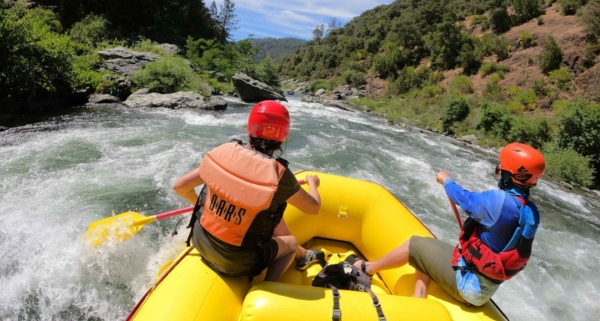
Navigating powerful Class IV whitewater requires specialized, commercial-grade personal protective equipment (PPE). You should never attempt to paddle the Ocoee River without the appropriate gear. Professional outfitters provide this equipment as part of your trip package to ensure it meets strict regulatory and safety standards.
The most critical piece of equipment is a Coast Guard-approved, high-flotation Personal Flotation Device (PFD). Unlike standard recreational life jackets, commercial whitewater PFDs are engineered with extra buoyancy and a secure profile. They are designed to keep your head above turbulent, aerated water if you fall out of the boat. Your guide will personally inspect and tighten your PFD straps to ensure it fits tightly against your torso.
To guarantee complete safety on the water, every rafter is required to use four essential pieces of gear:
- High-Flotation PFD: A Type V Coast Guard-approved life jacket explicitly engineered to keep a swimmer’s head above the heavily aerated water found in Class IV rapids.
- Whitewater Helmet: An impact-resistant, lightweight shell featuring proper drainage channels and a secure chin strap to protect against unexpected impacts.
- T-Grip Paddle: A heavy-duty, synthetic shaft tailored specifically to the paddler’s height to ensure maximum leverage and power.
- Thermal Wetsuit: Specialized full-body insulation provided by the outfitter during the cooler spring and autumn shoulder seasons.
A properly fitted whitewater helmet is mandatory for every rafter. The Ocoee River bed consists of slick, natural river rock and sharp granite shelves, particularly through the narrow Olympic section. Helmets protect against unexpected paddle strikes from crewmates or underwater hazards during a swim. Finally, lightweight, high-strength paddles allow you to deliver the instantaneous propulsion needed to punch through breaking waves.
What are the Age and Weight Restrictions for Rafting the Ocoee River?
Tennessee state law establishes strict age and safety boundaries for commercial rafting on the Ocoee River. To participate in any Ocoee whitewater trip, individuals must be at least 12 years of age or older. This age restriction is strictly enforced and cannot be waived by parental consent, regardless of a child’s swimming capabilities or height.
The physical demands of Class III and IV rapids require a certain level of physical maturity. A child must be old enough to understand and immediately execute complex safety commands in a high-stress environment. Additionally, participants must weigh at least 90 pounds to ensure that their safety equipment fits correctly.
The critical physical and metric restrictions for participants include:
- Minimum Permitted Age: Rafters must be at least 12 years old, which is a strict legal mandate across the Ocoee River corridor.
- Minimum Required Weight: Rafters must weigh at least 90 pounds to allow for a secure, custom fit of the commercial safety jackets.
- Physical Capability: All participants must be comfortable, capable swimmers who are in reasonable physical health.
If a guest does not meet the 90-pound threshold, standard commercial PFDs cannot be cinched tightly enough to prevent the user from slipping out of the jacket during a river rescue. These restrictions ensure that every rafter can be safely retrieved from the water if they unexpectedly go overboard.
How Do the Upper and Middle Sections of the Ocoee River Compare in Risk?
The Ocoee River is divided into two distinct commercial sections: the Upper Ocoee and the Middle Ocoee. While both sections feature Class III and IV rapids, they present completely different river profiles and hydrological challenges. Understanding these structural differences can help you better prepare for your trip.
The Upper Ocoee contains the official 1996 Olympic Slalom Whitewater Course. It is a highly technical, tightly compressed mile of whitewater built into a narrow granite gorge. The rapids here, such as Humongous and Godzilla, feature rapid-fire drops and powerful, swirling holes. The risk here involves swift, precise movements; if a raft misses an entry line by a matter of inches, the hydraulic force can easily flip the boat or launch a paddler.
Reviewing the specific hydrological profiles highlights the unique personality of each section:
- The Upper Ocoee Section: Characterized by a compressed granite gorge with short, technical recovery pools. The primary hazards are sharp drop-offs and intense hydraulic holes, perfectly illustrated by the famous Class IV rapid, Humongous.
- The Middle Ocoee Section: Characterized by a wide natural canyon with long, sustained recovery pools. The primary hazard comes from long, continuous wave trains that build in intensity, anchored by the iconic Class IV rapid, Table Saw.
In contrast, the Middle Ocoee is a longer, five-mile stretch through the Cherokee National Forest. It features classic, high-volume wave trains with large, crashing waves. Rapids like Table Saw and Diamond Splitter are highly continuous, meaning there is very little rest time between waves. However, the Middle section features wider channels and longer, deeper recovery pools at the end of major drops, making swimmer retrieval straightforward for your guide.
What Is the Proper Technique for Surviving an Unexpected Swim?
Falling out of a raft, commonly referred to as “taking a swim,” is an inherent part of whitewater rafting. If you fall into the river, the most critical safety rule is to remain calm and avoid panic. Your PFD will instantly bring you to the surface of the water, and your guide will immediately initiate a rescue plan.
The absolute gold standard for whitewater safety is the Downstream Swimming Position. You must immediately flip onto your back with your face up and your head positioned safely above the water line. Extend your legs straight out in front of you so that your feet are pointing directly downstream. Keep your toes pointing up out of the water and your knees slightly bent. This position allows your sturdy footwear to absorb any impacts with submerged boulders, acting as a bumper to protect your head and torso.
Never, under any circumstances, attempt to stand up in fast-moving whitewater. If you try to walk on the riverbed, you run the risk of foot entrapment. This happens when a foot wedges into a submerged rock crevice, and the powerful current forces your upper body underwater. Keep your hips high, float on your back, and use your arms to back-paddle toward your guide’s thrown rescue rope or the side of the raft.
How Does Outland Expeditions Manage Group Safety and Emergencies?
Outland Expeditions manages river safety through deep preparation, reliable communication, and continuous guide training. Our protocol begins long before we load the buses at our Cleveland, Tennessee outpost. Our gear is inspected daily for structural wear, and our specialized raft valves are double-checked to ensure optimal pressure.
On the river, our rafts travel as a coordinated fleet. We maintain clear visual contact between boats at all times. If a raft encounters a problem or loses a swimmer, the trailing rafts are positioned downriver to serve as safety lookouts and immediate rescue platforms. Our guides are fully certified in Swiftwater Rescue techniques and carry specialized safety gear, including high-strength throw bags and rescue carabiners.
Additionally, the Ocoee River corridor is bordered by US-64 through Polk County. This proximity provides excellent emergency vehicle access along our entire route. Outland Expeditions maintains direct communication channels with local emergency management networks. In the rare event of an injury, we can efficiently coordinate land-based extraction teams at designated river access points.
What Should You Wear to Ensure Personal Safety on the River?
Proper clothing choices are directly tied to your safety, physical comfort, and mobility on the water. The number one rule for whitewater rafting is to avoid cotton clothing entirely. Cotton absorbs water, stays heavy, and strips away your body’s natural heat, which can lead to hypothermia even during warm summer months.
Instead, opt for synthetic athletic apparel, nylon shorts, or high-performance swimsuits. These quick-dry fabrics shed water rapidly and allow for an unrestricted range of motion when paddling hard. If you are rafting during the cooler spring or autumn months, Outland Expeditions provides thermal wetsuits and splash jackets to keep your core temperature stable.
Our strict apparel safety parameters outline exactly how you should prepare:
- Approved Apparel: Moisture-wicking synthetic fabrics, lightweight nylon athletic shorts, and durable swimsuits.
- Prohibited Apparel: All cotton clothing items, heavy denim jeans, and baggy hooded sweatshirts that can fill with water.
- Required Footwear: Lace-up sneakers or rugged water shoes that secure firmly around the ankle.
- Prohibited Footwear: Flip-flops, pool slides, loose sandals without heel straps, or going entirely bare feet.
Your footwear choices are equally critical for your safety. You must wear secure shoes with an ankle strap, such as old running shoes or rugged water shoes. Flip-flops, pool slides, and bare feet are strictly prohibited on our trips. If your raft flips or you take an unexpected swim, loose footwear will instantly wash away, leaving your feet completely unprotected against sharp underwater rocks.
Conclusion: Book Your Next Adventure with Absolute Confidence
Prioritizing safety on the water ensures that your time on the Ocoee River is purely exhilarating. From mastering the downstream swimming position to using commercial-grade protective equipment, every safety protocol is designed to keep you secure through Class IV rapids. When you raft with experienced guides who prioritize group safety, you can leave your worries behind and focus entirely on the incredible thrill of the river.
Are you ready to experience the ultimate whitewater adventure in East Tennessee? Do not settle for an ordinary float trip when you can conquer the absolute best waves in the Southeast. Contact Outland Expeditions today to book your Full Ocoee River Experience or speak directly with our team to plan your perfect rafting day. Your next great outdoor adventure is waiting!
Frequently Asked Questions
Do I need to be an expert swimmer to raft the Ocoee River safely?
You do not need to be an expert swimmer, but you should be comfortable in moving water. Every guest is outfitted with a high-flotation PFD that keeps you afloat automatically if you fall out of the boat. However, being a comfortable swimmer helps you avoid panic, allowing you to easily follow instructions and swim to safety.
What happens if a raft flips over on the Ocoee River?
If a raft flips, it is a managed situation that our guides train for constantly. The entire crew will enter the water together, and the PFDs will quickly bring everyone to the surface. Your guide will immediately use their rescue training to upright the raft, collect paddles, and help pull swimmers back into the boat using trailing safety lines.
Can I bring my personal camera or cell phone on the raft?
We highly recommend leaving all cell phones, expensive cameras, and valuable items locked securely in your vehicle. The continuous Class III-IV waves will easily waterlog unprotected electronics or snap flimsy wrist straps. Outland Expeditions uses professional photographers along the riverbank to capture high-resolution photos of your trip, which are available for purchase after takeout.
How do we get back to our cars after the rafting trip concludes?
Outland Expeditions handles all the logistics and transportation for your trip. Once your raft reaches the designated takeout point, our custom transport buses will be waiting for you. We load all the gear and drive you directly back to our main outpost in Cleveland, Tennessee, where you can access our warm showers and changing rooms.
Does rain affect the safety or schedule of Ocoee rafting trips?
Rafting trips run rain or shine, and light rain does not affect river safety. Because the Ocoee River is dam-controlled, water levels remain highly predictable regardless of local rainfall. Trips are only delayed or rescheduled in the event of severe regional lightning storms or extreme flooding that impacts dam operations.
Can pregnant women participate in Ocoee River rafting trips?
No, pregnant women cannot participate in our whitewater rafting trips. Class III and IV rafting involves strenuous paddling, strong hydraulic forces, and jarring drops that pose significant physical risks. We prioritize maternal health and safety and invite you to join us on the river for a future season instead.


Leave a Reply
Want to join the discussion?Feel free to contribute!