
How to Fall Out of the Raft Properly (Yes, There’s a Right Way!)
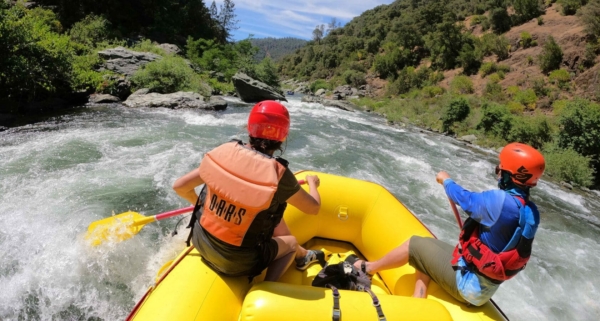
Falling out of a whitewater raft is one of those classic “what-if” scenarios that keeps first-time paddlers awake the night before a trip. Let’s be completely honest: when you are staring down a roaring Class IV wall of water like Humongous on the Upper Ocoee or Table Saw on the Middle Ocoee, the thought of taking an unexpected swim can feel incredibly intimidating.
However, taking a swim is a completely normal, common, and manageable part of the whitewater rafting experience. In the rafting world, we actually have a name for this: you aren’t “falling out,” you are simply becoming an “unintentional swimmer.”
The difference between a frantic, water-swallowing panic and an exciting, controlled adventure boils down to a few basic safety mechanics. Knowing how to fall out of a raft properly is the ultimate tool for staying safe and keeping your cool on the river. Let’s dive into the physics, the body mechanics, and the professional techniques that will keep you floating high and smiling wide.
Why Is Knowing How to Fall Out of a Raft Safely So Important?
When you embark on an adventure like our Full Ocoee River Experience, you are navigating ten miles of relentless, world-class Class III and IV whitewater. The Ocoee River is a powerful force of nature. Because the river is dam-controlled, its flows are highly precise and push through narrow, boulder-choked channels with immense energy.
If you fall out of the boat, you instantly transition from being a passenger in a structured watercraft to being an independent object in a high-velocity hydrologic system. Without a plan, your natural instinct is to fight the river, which wastes energy and increases the risk of inhaling water.
Our guides at Outland Expeditions are Swiftwater Rescue certified, meaning they undergo rigorous training to pull you out of the water quickly. However, the first few seconds of any swim belong entirely to you. Understanding the proper mechanics of falling out minimizes your time in the water, keeps you away from river obstacles, and makes it vastly easier for your guide to pull you back on board.
What Is the Defensive Whitewater Swimming Position?
If you find yourself in the water, your absolute default posture must be the defensive whitewater swimming position, often summarized by guides as “nose and toes up.”
To assume this position, lay flat on your back and let your Coast Guard-approved Personal Flotation Device (PFD) do its job of keeping your chest and shoulders high above the water. Extend your legs straight out in front of you with your feet pointing downstream, keeping your knees slightly bent to absorb any impacts with underwater rocks. Keep your toes pointed up toward the sky and your nose aimed in the same direction.
This posture serves three crucial purposes:
- Visual Awareness: Having your head tilted back and looking downstream allows you to see exactly what rapids, waves, or obstacles are coming your way next.
- Impact Absorption: If you drift toward a rock, your strong, rubber-soled water shoes or sneakers will take the impact instead of your head, knees, or tailbone.
- Foot Entrapment Prevention: This is the single most critical safety rule in whitewater. By keeping your feet high at the surface, you eliminate the risk of getting a foot wedged between underwater boulders in the riverbed.
Why Should You Never Try to Stand Up in Swift Water?
It is the most natural human instinct in the world: when you fall into water, you want to put your feet down to stand up. On a swift, rocky riverbed like the Ocoee, attempting to stand up in moving water is the single most dangerous mistake a swimmer can make.
This danger is known as foot entrapment. When the riverbed is covered in loose rocks, cracks, and boulders, placing your foot down allows the powerful current to push your leg deep into a crevice. Once your foot is wedged, the force of the rushing water (which can weigh thousands of pounds per second) will push your body forward and hold you underwater.
No matter how shallow or calm the water looks, never attempt to stand up in moving current. You must remain in the defensive swimming position on your back until you have floated completely through the rapid and reached a calm, slow-moving pool or a quiet eddy near the shoreline. Only when the water is totally still and your guide gives you the clear signal should you stand up.
How Do You Handle the Split Second You Exit the Boat?
A proper swim actually starts the precise moment you realize you are leaving the raft. While gravity and hydraulics do their work, you have a split second to make two crucial adjustments that will set you up for a safe recovery.
First, you must secure your paddle. Always keep one hand firmly wrapped around the plastic “T-grip” at the end of your paddle shaft. A loose paddle floating in a rapid becomes a dangerous projectile that can strike your fellow rafters or your own face. If you manage to hold onto your paddle, hold it across your chest while floating on your back; if it becomes too difficult or dangerous to hold, let it go immediately so you can focus on swimming.
Second, try to push yourself slightly away from the side of the raft as you fall. You want to avoid falling directly underneath the rubber tubes or getting your limbs tangled in the exterior perimeter lines of the boat. Pushing off slightly ensures you land in clear water, allowing your PFD to immediately pop you back up to the surface.
When Should You Switch to the Active Swimming Position?
While the defensive swimming position is perfect for riding out big waves and avoiding rocky obstacles, it is entirely passive. It will keep you safe, but it won’t move you closer to safety. There are times when you must transition to active swimming to rescue yourself.
Active swimming is exactly what it sounds like: flipping over onto your stomach and using an aggressive crawl stroke to drive yourself across the current. You should switch to active swimming when:
- An Eddy is Close: If you see a calm pool of water behind a large boulder (an eddy) or a quiet spot near the riverbank, flip over and swim hard toward it.
- You Need to Reach the Boat: If the raft is sitting in calm water just a few feet away, active swimming is the fastest way to close the gap.
- You Face a Downstream Hazard: If there is a fallen tree (strainer) or a dangerous rock ahead, you must actively swim diagonally across the current to clear the hazard.
When active swimming, always angle your body at roughly a 45-degree angle pointing toward your target destination. This allows you to work with the current rather than fighting directly against it, saving precious physical energy.
How Does a Professional Whitewater Rescue Work?
At Outland Expeditions, our team is trained to execute seamless, rapid water rescues. We utilize a variety of tools to get you out of the river and back into the boat within seconds.
The primary tool for long-distance rescues is the throw bag. This is a highly visible rescue rope packed inside a floating bag. If you are floating too far from the raft, your guide or a safety boater will yell “Rope!” and toss the bag directly over your chest or arms.
How to Hold a Throw Rope: If a rope lands near you, grab the rope itself—never loop the rope around your wrists, neck, or hands. Wrap your chest over the rope, turn onto your back with your head pointing upstream (so the water splashes over your helmet rather than into your face), and hold tight while your guide pulls you back to the boat.
If you are close to the raft, your guide or a crew member will reach out to pull you in. Always make eye contact, listen for commands, and prepare for a classic “face-to-face” assist.
1.Establish contact and drop your paddle:Within 5 seconds.
As you reach the raft, let your paddle float alongside or hand it to a crew member. Reach up and grab the rescue straps or the shoulder straps of your rescuer’s PFD. Do not grab the rim of the raft.
2.Allow the rescuer to grab your PFD shoulders:Within 10 seconds.
Your rescuer will grab the two thick shoulder straps on your PFD. They will not grab your hands or arms, as this can dislocate joints. Keep your body relaxed and let them take a firm grip.
3.Kick your legs to create lift:Within 15 seconds.
When your rescuer yells “1, 2, 3, pull!”, give a hard, aggressive kick with your legs in the water. Kicking pushes your hips up to the surface, reducing drag against the rubber tube of the raft.
4.Get pulled in face-to-face:Within 20 seconds.
The rescuer will use your momentum and their body weight to slide you chest-first over the side tube of the raft. You will slide in face-down, landing safely on the floor of the boat.
Ready to Conquer the Ocoee River with Outland Expeditions?
Now that you know the exact science behind falling out of a raft, you are fully prepared to handle anything the Ocoee River can throw your way. Whitewater rafting is an exhilarating sport, and having a firm grasp of these safety concepts turns a potential moment of worry into a boost of pure confidence.
At Outland Expeditions, we specialize in delivering the ultimate Ocoee River rafting experience. Our Full Ocoee River Experience combines the technical, high-intensity Olympic Course with the classic, big-volume drops of the Middle Ocoee. With our elite, Swiftwater Rescue certified guides steering your raft, you will navigate more than 20 legendary rapids with the best safety team in the Southeast.
Our state-of-the-art outpost in Cleveland, Tennessee features clean changing facilities, hot showers, and everything you need for a comfortable day on the water. Don’t let the fear of a splash keep you from the adventure of a lifetime.
Contact Outland Expeditions today to book your spot on our next weekend adventure!
Frequently Asked Questions
What should I do first if I fall out of a whitewater raft?
The very first thing you should do is stay calm and allow your high-buoyancy PFD to bring you back to the surface. Once your head clears the water, immediately look downstream, assume the defensive swimming position on your back, and locate your raft or your guide.
Can I wear sandals if I fall out of the raft?
Sandals without a heel strap are not permitted on our trips because they easily slide off your feet in the river current. If you fall out, you need secure footwear like water shoes or old sneakers to protect your feet from rocks and provide traction when stepping on wet surfaces.
Is the defensive swimming position safe for Class IV rapids?
Yes, the defensive swimming position is the safest posture for navigating Class IV rapids like those on the Upper Ocoee. Keeping your feet pointing downstream at the water’s surface prevents foot entrapment and allows your shoes to absorb any impacts with obstacles.
How do guides pull a swimmer back into the raft?
Guides pull swimmers back into the raft by grabbing the shoulder straps of the swimmer’s PFD and pulling them face-first over the rubber tubes. Swimmers help by kicking their legs aggressively to lift their lower body over the side of the boat.
What is foot entrapment and why is it dangerous?
Foot entrapment occurs when a swimmer tries to stand up in fast-moving water and gets their foot wedged in a rocky crevice. The immense pressure of the moving current can push the swimmer forward and hold them underwater, which is why you must never try to stand up in a rapid.
Do I need to be a strong swimmer to go rafting on the Ocoee?
While you do not need to be an Olympic-level swimmer, you should be a comfortable, confident swimmer who does not panic in the water. Everyone on our trips is required to wear a Coast Guard-approved PFD, which provides significant buoyancy to keep you afloat automatically.


Leave a Reply
Want to join the discussion?Feel free to contribute!