
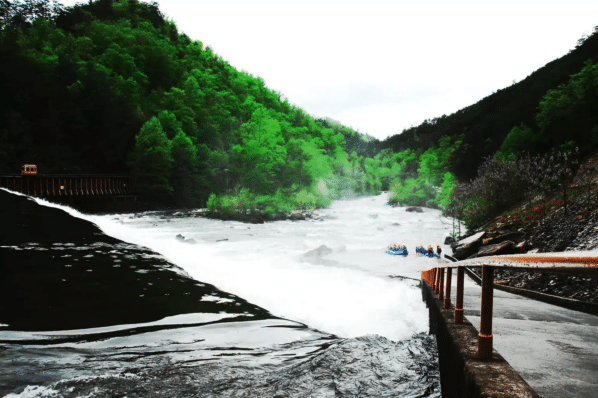
What Every Beginner Should Know About River Hydrodynamics
For most beginners, standing at the edge of a rushing river can feel intimidating. The water roars, crashes against boulders, and swirls in what looks like absolute chaos.
But underneath that spray and noise is a highly predictable set of physical laws. Welcome to the world of river hydrodynamics—the science of how water moves, reacts, and interacts with the riverbed and your raft.
Understanding these fluid dynamics transforms the river from a chaotic washing machine into a thrilling, readable highway. Let’s break down the core principles of river currents, waves, and obstacles so you can feel confident, prepared, and excited to tackle the legendary Class III and Class IV rapids of the Ocoee River.
What Exactly Is River Hydrodynamics and Why Does It Matter to a Rafter?
At its simplest, river hydrodynamics is the study of water in motion. When applied to whitewater rafting, it refers to how the forces of gravity, channel shape, and friction combine to create currents, waves, and obstacles.
Water always seeks the path of least resistance. Gravity pulls the water downslope, while friction from the riverbank, boulders, and the riverbed slows it down. This struggle between gravity and friction creates the dynamic features we call rapids.
For a beginner, learning the basics of this science is the ultimate cheat code. It shifts your perspective from fighting the river to working with it. You will understand why your guide steers the raft into certain waves and avoids others, making you a much more active and synchronized paddler.
How Does a River Current Behave in Different Sections?
A river current does not flow at a uniform speed from bank to bank. Because of friction, water moves at different velocities depending on where it is in the channel.
The fastest-moving water is typically found just below the surface, in the center of the deepest part of the channel. Here, the water is farthest from the friction-heavy banks and rocky river bottom. This high-velocity zone is known as the thalweg.
When a river bends, hydrodynamics dictate that the fastest water shifts to the outside of the curve. The outside bend experiences erosion, while the inside bend—where the water slows down—often features gravel bars or calm shallow areas. Recognizing where the fast and slow water lies is crucial for navigating tight turns on technical rivers.
What Are Eddies and How Do You Use Them?
An eddy is an area of relatively calm, swirling water that forms downstream of an obstruction, such as a large boulder, a bridge piling, or a sharp bend in the river bank.
As the main river current rushes past an obstacle, it cannot immediately fill the empty space directly behind it. This creates a low-pressure zone. Water from downstream is sucked upward to fill this void, creating a circular current that actually flows upstream.
- The Eddy Line: The boundary separating the downstream current from the upstream-flowing eddy. Crossing this boundary requires active paddling because the opposing forces can easily spin a raft.
- The Sanctuary: Once inside an eddy, the water is calm. Rafting trips use eddies as natural pit stops to rest, regroup, scout upcoming rapids, or wait for other rafts to pass.
Learning how to “peel out” of an eddy or “catch” an eddy is one of the very first physical skills a whitewater rafter practices. It is the river’s version of an exit ramp and parking space.
What Are Whitewater Hydraulics and How Do They Form?
When river professionals talk about whitewater hydraulics, they are referring to water formations created by vertical drops. These are commonly called “holes,” “rollers,” or “reversals.”
When water flows rapidly over a submerged boulder or a ledge, it drops sharply on the downstream side. The water rushing over the drop creates a deep depression. To fill this depression, water from further downstream recirculates back upstream along the surface.
If a hydraulic is small, it creates a fun, bouncy wave that a raft can easily punch through with forward momentum. However, very deep, wide hydraulics can act like a giant water trap, holding objects in their recirculating loop. Experienced guides know exactly which hydraulics are safe to play in and which ones must be bypassed entirely.
How Do You ‘Read’ the River Like an Expert?
“Reading” the river means looking at the surface of the water and instantly understanding the deep-water topography and current patterns underneath. Guides spend years perfecting this skill, but beginners can look for a few key visual clues.
The Downstream “V”
When water flows between two obstacles (like two large boulders), it constricts and speeds up, forming a smooth, dark, tongue-shaped wedge pointing downstream. This “V” is almost always the deepest, safest path of clean water through a rapid.
The Upstream “V”
If you see a “V” shape pointing upstream, it indicates a submerged rock or obstacle just below the surface. The water is splitting and flowing around the rock. You want to avoid the point of an upstream “V” to keep from getting stuck on a hidden boulder.
Standing Waves
Waves that stay in one place rather than traveling are called standing waves. They form when fast-moving water slows down abruptly, or when a fast current runs into deeper, slower water. These waves offer the classic, roller-coaster splashes that make whitewater rafting so addictive.
How Does Outland Expeditions Apply Hydrodynamics on the Ocoee River?
On a guided trip with Outland Expeditions, you get to see these principles in action on one of the country’s premier whitewater rivers. The Ocoee River is dam-controlled, meaning the water volume and flow velocity are regulated by the Tennessee Valley Authority (TVA). This creates exceptionally consistent, reliable, and thrilling hydrodynamics.
On our Full Ocoee River Experience, you will navigate two completely different hydrologic environments back to back:
- The Upper Ocoee (The Olympic Section): This section features a narrow, technical, granite gorge built specifically for the 1996 Atlanta Olympic Slalom games. The hydrodynamics here are highly compressed and fast. You will feel the raw power of tight hydraulics at famous rapids like Humongous and Godzilla.
- The Middle Ocoee: This five-mile stretch offers classic, big-volume river flow. Rapids like Table Saw, Hell’s Hole, and Diamond Splitter showcase massive standing waves and wide, deep-channel hydraulics that demand coordinated team paddling to conquer.
Our Swiftwater Rescue-certified guides understand these unique river dynamics inside and out. They know exactly how the river current will react to daily water releases, ensuring your trip is as safe as it is exhilarating.
Ready to Feel the Force of the Ocoee Yourself?
Now that you know the science behind the splashes, it’s time to experience it live. There is a massive difference between reading about a hydraulic and feeling your raft rise, crash, and power through one of the Ocoee’s legendary Class IV drops.
Whether you are looking to tackle the historic Olympic course of the Upper Ocoee, run the classic Middle Ocoee, or spend an epic six hours conquering both on our Full Ocoee River Experience, Outland Expeditions is ready to guide you. We handle all the gear, the logistics, and the expert navigation—all you need to bring is your sense of adventure.
Contact Outland Expeditions today to book your spot on Tennessee’s ultimate whitewater river!
Frequently Asked Questions About River Physics and Rafting
What is the difference between laminar and turbulent flow in a river?
Laminar flow occurs when water molecules travel in smooth, parallel paths, typically in slow-moving, deep pools. Turbulent flow happens when the velocity increases and the water encounters obstacles, causing the fluid particles to mix, swirl, and create the aerated “white” water we see in rapids.
Why does a river look white in a rapid?
The white color in rapids is caused by aeration. When fast-moving, turbulent water crashes over rocks and drops, it mixes with the air. Millions of tiny air bubbles get trapped in the water, which reflect light in all directions and make the current appear bright white.
Is the Ocoee River natural or artificial?
The Ocoee River is a natural river flowing through the Cherokee National Forest, but its water flow is managed by a series of dams. These controlled releases create predictable, world-class whitewater conditions on scheduled days, bypassing the unpredictable droughts that affect purely rain-fed rivers.
Do I need to be a strong swimmer to handle Class IV rapids?
While you do not need to be an Olympic athlete, you should be a comfortable swimmer who is not afraid of water. Everyone on an Outland Expeditions trip is outfitted with a high-float, Coast Guard-approved Personal Flotation Device (PFD) and a helmet, and our guides will thoroughly instruct you on “active swimming” techniques before hitting the water.
What is a “reversal” and is it dangerous?
A reversal is another name for a hydraulic or “hole.” It is a wave that curls back on itself upstream. While small reversals are perfectly safe and provide great splashes, large, industrial-sized reversals (often found near man-made dams) can be dangerous. Outland Expeditions’ guides are expertly trained to steer rafts safely around any hazardous river features.


Leave a Reply
Want to join the discussion?Feel free to contribute!