
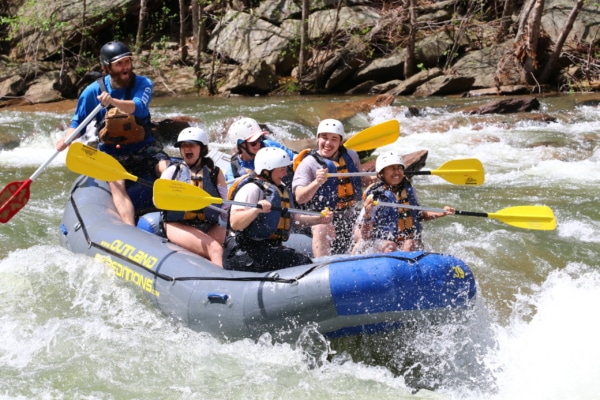
The Psychology of Adventure: Why Rafting Boosts Confidence
Have you ever wondered why standing on the edge of a rushing river makes your heart pound, yet stepping off the raft at the end of the day makes you feel completely invincible? This profound shift isn’t just an accidental rush of good feelings. It is a predictable, scientifically documented psychological phenomenon rooted in how the human mind processes calculated risk, physical challenge, and outdoor exploration.
The psychology of adventure reveals that when we step outside the predictable confines of modern comfort, our brains undergo a dramatic rewiring process. Navigating high-stimulus outdoor environments acts as an intense crucible for personal growth, fundamentally altering how we view our own capabilities. For those seeking a tangible, accessible path to building lasting confidence, few activities match the immediate, transformative power of whitewater rafting.
By examining the intersection of sports psychology, neurobiology, and wilderness immersion, we can uncover the exact mechanisms that transform raw river rapids into a powerful engine for self-actualization. You will learn how intentional exposure to stress resets your nervous system, how shared physical challenges forge unbreakable social bonds, and how conquering legendary whitewater provides a psychological blueprint for overcoming the everyday anxieties of modern life.
How Does Facing Class III and IV Rapids Rewire the Human Stress Response?
At the core of the psychology of adventure lies a fundamental biological truth: your brain cannot easily distinguish between a existential threat and a controlled, recreational thrill. When your raft plunges into a high-volume Class III or Class IV rapid, your sympathetic nervous system initiates a classic fight-or-flight response. Your adrenal glands flood your bloodstream with cortisol and adrenaline, sharpening your visual acuity, accelerating your heart rate, and preparing your muscles for immediate, explosive action.
However, when you are under the care of a highly trained professional outfitter, this primal stress response undergoes a crucial psychological conversion. Because you are equipped with high-grade safety gear and guided by a Swiftwater Rescue certified professional, your mind shifts from a state of paralyzing panic to a state of high-performance focus. Psychologists call this positive manifestation of stress eustress. Unlike chronic, draining daily stress, eustress acts as a powerful cognitive stimulant that enhances focus, unites physical coordination, and strips away external mental distractions.
Once your raft successfully punches through the crashing hydraulic wave of a signature rapid, a spectacular chemical shift occurs in your brain. The acute drop in perceived danger causes the brain to stop producing stress hormones and instead release a massive surge of dopamine and endorphins. This rapid neurochemical transition creates an intense wave of euphoria and relief. By repeatedly cycling through this state of high tension and subsequent triumph over the course of a multi-hour river trip, you effectively retrain your nervous system to view challenging situations not as threats to be avoided, but as obstacles that can be actively overcome.
Why Is Self-Efficacy the Secret Key to Lasting Personal Confidence?
Many people mistake confidence for a vague, general sense of optimism or high self-esteem. However, renowned psychologist Albert Bandura established that the truest, most resilient form of internal confidence is actually self-efficacy—an individual’s specific, data-backed belief in their ability to execute behaviors necessary to produce specific performance attainments. You do not build genuine self-efficacy by reading inspiring quotes; you build it through what Bandura termed “mastery experiences.”
Whitewater rafting serves as an ideal catalyst for creating these definitive mastery experiences because it offers immediate, unambiguous feedback. When you look downriver at a terrifying obstacle, listen to your guide’s commands, dig your paddle deep into the churning water, and successfully navigate the obstacle, your brain registers an undeniable personal victory. The feedback loop is instantaneous: you faced a clear physical challenge, applied effort and strategy, and achieved a successful outcome.
This tangible accumulation of micro-victories builds a robust psychological foundation that naturally transfers over to your personal and professional life. When you return to the normal world and face a high-pressure corporate presentation, a difficult academic exam, or a daunting personal transition, your subconscious draws upon your recent experiential data. The internal narrative shifts from “I don’t know if I can handle this” to “I successfully paddled through massive Class IV rapids last weekend, so I absolutely have the capacity to handle this stressful situation today.”
How Does the Controlled Risk of a Guided River Trip Accelerate Mental Growth?
True mental resilience cannot develop in an environment of total safety and predictability. To expand the boundaries of what your mind perceives as possible, you must intentionally expose yourself to controlled risks. The key word is controlled. Unmanaged, reckless risk can lead to genuine trauma and a regression in self-confidence; conversely, structured risk within a managed framework provides the exact environmental pressure required for rapid psychological maturation.
A professional whitewater expedition balances these forces perfectly by matching a highly dynamic environment with rigorous operational safety. Participants are placed directly into the path of booming hydraulics and roaring currents, creating a profound, visceral illusion of danger. Yet, beneath that surface-level chaos sits a strict architecture of risk management:
- Coast Guard-Approved PFDs (Personal Flotation Devices): Specialized, high-buoyancy vests designed to keep rafters safely afloat in turbulent whitewater.
- Swiftwater Rescue Certification: Intensive professional training that equips river guides to read complex hydrology, manage river currents, and execute precise extractions.
- Pre-Trip Paddle Briefings: Standardized instructional sessions that translate complex river mechanics into simple, actionable commands for the entire crew.
Operating within this protective framework allows individuals to step completely out of their psychological comfort zones without taking on unmanaged physical peril. It provides an optimal zone of proximal development—a mental space where the challenge is high enough to demand your absolute best performance, but the safety net is secure enough to prevent psychological collapse. Conquering a river under these terms expands your comfort zone permanently, leaving you fundamentally more adaptable and less risk-averse in your everyday decision-making.
What Role Does Shared Team Cohesion Play in Building Individual Self-Worth?
While the internal psychological shifts of adventure are profound, the social dynamics of a shared river trip add a massive second layer of confidence-building power. A whitewater raft cannot be successfully steered by a single individual; it requires an absolute synthesis of effort from every single person on board. This structural reality forces an immediate, organic development of high-level team cohesion.
When a group enters a rapid, individual identities, social hierarchies, and personal insecurities instantly melt away. The group is forced into a state of absolute behavioral synchronization. You must match the paddle stroke of the person in front of you, balance your weight with the person opposite you, and respond in unison to the sharp verbal commands of your guide. This forced collaboration triggers a deep neurological mirror-neuron response, fostering an intense, immediate sense of mutual trust and social belonging.
Individual Anxiety ──> Shared Group Synchrony ──> Collective Success ──> Amplified Individual Self-Worth
Experiencing this collective triumph provides an intense boost to individual self-worth. In a world where modern isolation and digital communication can leave people feeling disconnected, being part of a highly functional physical team provides a primitive, deeply satisfying validation of one’s place within a social unit. You realize that your individual effort directly contributed to the survival and success of the group, and that realization anchors a deep, unshakeable sense of social confidence and personal capability.
How Can Conquering a World-Class Whitewater Experience Permanently Alter Your Mindset?
To truly experience the full spectrum of adventure psychology, one must move past casual, entry-level excursions and seek out a sustained, comprehensive challenge. Testing your mental fortitude across a diverse, multi-stage environment provides the ultimate proof of your internal adaptability. This is precisely why tackling an immersive, multi-section river journey yields such transformative psychological results.
On a world-class river corridor like Tennessee’s Ocoee River, a full-day journey acts as a perfect narrative arc for psychological transformation. When you choose to run a comprehensive trip like the Full Ocoee River Experience with Outland Expeditions, you are not just signing up for a standard commercial tour. You are committing to a continuous, ten-mile psychological gauntlet that features more than twenty distinct named rapids across two completely different river ecosystems.
The journey begins on the Upper Ocoee, the technical, compact mile of world-class water that hosted the 1996 Atlanta Olympic Games. Navigating rapids like Humongous, Godzilla, and Edge of the World requires instant, razor-sharp focus and precise technical execution. This morning session shocks your system out of its everyday complacency, forcing your brain to rapidly adapt to intense, world-championship-caliber hydraulics.
After conquering the Olympic course, a deliberate, restorative riverside lunch provides a crucial psychological pause. This break allows your nervous system to down-regulate, shifting your mind out of acute performance mode so you can process your morning victories and mentally prepare for the next phase.
In the afternoon, you drop directly into the Classic Middle Ocoee—a relentless five-mile stretch through the breathtaking Cherokee National Forest. Here, the river changes character entirely, demanding long-term physical endurance and sustained mental resilience through iconic drops like Table Saw, Hell’s Hole, and Diamond Splitter.
By the time you successfully complete this massive six-hour journey and return to the outpost in Cleveland, Tennessee for a warm shower, your mental landscape has completely shifted. You haven’t just paddled a boat; you have sustained absolute focus, adapted to wildly shifting environmental challenges, trusted your team, and successfully overcome twenty consecutive Class III and IV obstacles. The sheer volume of experiential evidence gathered across those ten miles makes it impossible for your brain to return to its old, self-limiting beliefs. You leave the river as a fundamentally more capable, self-reliant, and confident individual.
Ready to Rewrite Your Limits?
Confidence isn’t something you wait to discover—it is something you actively build out on the water. If you are ready to trade modern mental fatigue for world-class focus, break through your perceived limits, and forge an unshakeable sense of self-reliance, the river is waiting for you. Contact Outland Expeditions today to secure your seat on the ultimate Full Ocoee River Experience. Let our expert, certified crew handle the logistics while you step into the transformative psychology of adventure.
Frequently Asked Questions About Adventure Psychology and Rafting
Do I need prior whitewater rafting experience to experience these confidence benefits?
No, prior experience is absolutely not required to build self-efficacy on the river. Outfitters like Outland Expeditions provide a comprehensive safety and paddle briefing before launching, and an expert, certified guide sits in every single raft to manage technical navigation. The psychological benefits of facing the unknown are often even more pronounced for confident first-timers, as the gap between their perceived limits and their actual achievements is much wider.
What is the minimum age and physical requirement for high-stimulus rafting trips?
For advanced runs like the Full Ocoee River Experience, participants must be at least 12 years of age and weigh a minimum of 90 pounds to ensure a secure, proper fit in standard Coast Guard-approved PFDs. You do not need to be an elite athlete, but participants should be comfortable swimmers, in reasonable physical health, and prepared for a highly active, six-hour outdoor adventure.
How does rafting differ from other outdoor sports in building mental resilience?
While solo adventure sports like rock climbing or trail running build excellent personal self-reliance, whitewater rafting is unique because it perfectly pairs individual stress-exposure with intense, mandatory team synchronization. The necessity of executing physical movements in perfect harmony with a crew creates a unique blend of personal self-efficacy and collective social trust that solo outdoor activities simply cannot replicate.
Is it normal to feel intense anxiety or fear before a major whitewater trip?
Feeling pre-trip anxiety is an incredibly common, completely natural biological response to high-stimulus wilderness environments. Within the framework of adventure psychology, this initial fear is not a sign of weakness—it is the essential raw material required for growth. Without real, palpable fear at the putting-in point, your brain cannot experience the massive, confidence-building neurochemical release of dopamine and self-efficacy that occurs once you successfully navigate the rapids.
How long do the psychological benefits of an adventure trip typically last?
While the acute chemical rush of dopamine and endorphins will naturally taper off within 24 to 48 hours after your trip, the structural psychological changes to your self-efficacy are permanent. The concrete memory of facing down a daunting, chaotic obstacle like a Class IV rapid and successfully navigating it remains stored in your long-term memory as a definitive “mastery experience,” providing an enduring psychological anchor you can draw upon for years to come.


Leave a Reply
Want to join the discussion?Feel free to contribute!