
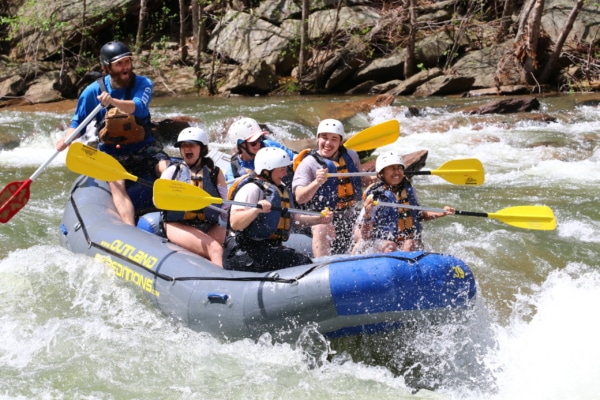
How Guides Keep Rafters Safe on the Ocoee River
Whitewater rafting on the Ocoee River offers fast-moving rapids, technical features, and continuous action through the Cherokee National Forest region. For guests ages 12 and older experiencing Class III and IV whitewater for the first time, the question of safety is rarely far from mind.
The difference between an exciting trip and a dangerous situation often comes down to one factor: the guide in your raft.
This article explains how professional rafting guides keep guests safe on the Middle Ocoee, Upper Olympic Ocoee, and Full Ocoee. You’ll learn what guides do before, during, and after a trip, how they manage risk in real time, and what makes Outland Expeditions’ approach to safety effective after over 45 years on the river.
What Guides Do Before the Trip Begins
Safety starts before the raft enters the water. Guides prepare guests through structured briefings that cover equipment, paddling technique, and emergency procedures.
Equipment Check and Fitting
Every guest receives a personal flotation device (PFD), helmet, and paddle. Guides verify that each PFD is properly fastened and fits snugly enough to stay in place during a swim. Helmets are adjusted to sit low on the forehead without obstructing vision. Paddles are sized to each guest’s height and seated position in the raft.
Guides also inspect rafts for proper inflation, secure D-rings, and functional straps before loading guests.
Safety Briefing
Before launching, guides explain what to expect on the water. This briefing covers:
- Paddle commands: Forward, back, left turn, right turn, stop.
- Body positioning: How to sit on the raft’s edge with feet tucked under the thwart for stability.
- Swimming position: Feet up, on your back, facing downstream if you fall out.
- Self-rescue: How to grab the raft’s perimeter line and pull yourself back in.
- Throw bag protocols: What to do if a guide deploys a rescue rope.
Guides emphasize listening for commands and acting immediately. Hesitation in Class III and IV whitewater can turn a manageable situation into a problem.
Section-Specific Considerations
The Middle Ocoee, Upper Olympic Ocoee, and Full Ocoee each present different safety factors. Guides tailor their pre-trip briefings to the section being run.
The Middle Ocoee offers continuous action with frequent wave trains and hydraulics. Guides prepare guests for sustained effort and rapid sequences with minimal flat water between features.
The Upper Ocoee includes the 1996 Olympic whitewater course, where technical features like Humongous, Double Suck, and Broken Nose require precise positioning and quick reactions. Guides explain these named rapids in advance and describe the consequences of missing a line.
For Full Ocoee trips combining both sections, guides reinforce the importance of sustained focus over a longer day on the water. Fatigue becomes a risk factor, so guides watch for signs of exhaustion and adjust commands accordingly.
How Guides Read the River
A guide’s most important skill is the ability to read water. This means identifying hazards, predicting current behavior, and selecting the safest path through a rapid.
Identifying Hazards
Guides scan for:
- Rocks: Subsurface obstacles that can flip or pin a raft.
- Hydraulics: Recirculating water behind rocks or drops that can hold a swimmer.
- Strainers: Fallen trees or debris that allow water to pass through but trap solid objects.
- Undercut rocks: Ledges where current flows beneath the surface, creating entrapment zones.
Experienced guides recognize these features by water surface patterns: calm spots indicate deep pools, standing waves signal submerged rocks, and foam piles often mark hydraulics.
Choosing a Line
Once hazards are identified, guides select a route through the rapid. This involves:
- Scouting: Visually tracing the safest path from upstream.
- Positioning: Entering the rapid at the correct angle to follow the desired line.
- Adjusting: Making real-time corrections based on current speed, raft drift, and guest paddling effectiveness.
On the Ocoee, the margin for error is often narrow. Rapids like Broken Nose on the Upper Olympic section require threading between rocks with minimal room for deviation. Guides use paddle commands to steer the raft precisely, compensating for guest paddle strokes that may be mistimed or weak.
Anticipating Guest Behavior
Guides account for unpredictable guest actions. First-time rafters may freeze during a command, paddle out of sync, or shift weight incorrectly. Guides build these variables into their plan, choosing lines with wider margins when paddling skill is uneven.
For corporate teams, bachelor parties, or church groups with mixed experience levels, guides often simplify commands and rely more heavily on their own steering to compensate for inconsistent guest input.
How Guides Manage Risk During the Trip
Once on the water, guides actively manage safety through positioning, communication, and real-time decision-making.
Raft Positioning
Guides control the raft’s position in the current using draw strokes, pries, and rudder techniques. Proper positioning prevents collisions with rocks, keeps the raft aligned for wave trains, and sets up clean entries into rapids.
In big water sections like Tablesaw on the Middle Ocoee, guides use ferry angles to move laterally across the current, avoiding holes and positioning for the next feature. Poor positioning here can result in flipping or wrapping the raft on a rock.
Verbal Commands
Guides issue commands loudly and clearly, often repeating them multiple times. In the roar of Class IV whitewater, guests may miss the first call. Effective guides anticipate this and over-communicate rather than assume compliance.
Commands are specific: “Forward hard three strokes” is more effective than “Paddle.” Guides also use countdowns to synchronize effort: “One, two, three, back!” This helps guests who struggle with timing.
Physical Assistance
Guides physically assist guests when necessary. If a paddler is about to fall out due to a wave or shift in raft position, the guide may brace them with a paddle or hand. During a flip scenario, guides prioritize getting swimmers to safety before attempting to right the raft.
Swimmer Recovery
When a guest falls out, guides execute a recovery sequence:
- Verbal contact: Call to the swimmer to confirm they are conscious and oriented.
- Positioning: Maneuver the raft downstream of the swimmer so current pushes them toward the raft, not away.
- Grab assist: Instruct the swimmer to grab the perimeter line or extended paddle.
- Pull-in: Use a one-handed pull or coordinated effort with other guests to haul the swimmer back into the raft.
If a swimmer is separated from the raft in continuous rapids, guides use throw bags to establish a line. The swimmer grabs the rope, and the guide pulls them to the raft or shore, depending on proximity and rapid structure.
Communication Between Rafts
Outland Expeditions runs trips with multiple rafts. Lead guides communicate with sweep guides using hand signals or verbal calls to coordinate spacing, warn of hazards, and track guest counts. If one raft flips or has a swimmer, other guides adjust positioning to assist.
This coordination is especially important on the Upper Olympic Ocoee, where technical rapids occur in quick succession. A raft that flips in Humongous may need immediate support before entering the next rapid.
What Guides Do in Emergency Situations
Despite preparation and skill, emergencies can occur. Guides train for scenarios including flips, entrapments, medical events, and equipment failure.
Raft Flips
When a raft flips, guides prioritize swimmer safety. The first action is a head count. Guests are trained to swim to the overturned raft and hold the perimeter line until the guide can right it or until rescue arrives.
Guides assess whether to flip the raft immediately or swim it to shore. In continuous rapids, attempting to flip mid-river can re-expose swimmers to hazards. Guides make this decision based on rapid structure, swimmer condition, and downstream obstacles.
Entrapment
Foot entrapment occurs when a swimmer’s foot becomes wedged between rocks in shallow, fast-moving water. This is a high-risk scenario. Guides instruct guests never to stand in moving water for this reason.
If entrapment occurs, the guide stabilizes the swimmer’s position and works to free the foot while preventing the current from pushing the swimmer under. This often requires multiple guides and can necessitate cutting footwear.
Pinned rafts (rafts wrapped around rocks by current pressure) are managed by redistributing weight, using ropes to pivot the raft, or deflating sections to reduce surface area. Outland Expeditions guides carry rescue equipment for these situations.
Medical Emergencies
Guides are trained in wilderness first aid and CPR. Common medical events include hyperventilation, heat exhaustion, and minor injuries from paddle strikes or rock contact.
For serious injuries, guides stabilize the guest, signal for support, and coordinate evacuation. The Ocoee has multiple road access points, allowing relatively quick extraction in most sections. Guides carry communication devices to contact base operations and emergency services.
Equipment Failure
Paddle breaks, PFD malfunctions, and raft punctures are rare but possible. Guides carry spares and repair kits. A broken paddle is replaced immediately. A punctured raft can be patched or the affected chamber isolated if the raft has multiple air chambers, which all Outland Expeditions rafts do.
How Guides Adapt to Different Guest Groups
Guest composition affects how guides manage safety. Families with older kids, friend groups, corporate teams, and bachelor or bachelorette parties each require different approaches.
Families with Older Kids
Parents often worry about their children’s safety. Guides address this by placing younger or smaller guests in the center of the raft, where they are less likely to be ejected during big waves. Guides also simplify commands and provide more frequent encouragement.
For families on the Middle Ocoee, guides emphasize the section’s suitability for first-time rafters while maintaining vigilance during larger rapids like Double Trouble.
Friend Groups and Bachelor Parties
These groups often bring high energy and competitive dynamics. Guides channel this into effective paddling but watch for overconfidence. Guests who ignore commands or attempt risky behavior mid-rapid create hazards for themselves and others.
Guides establish authority early in the trip and reinforce the consequences of non-compliance. Most guests respond well once they experience the river’s power firsthand.
Corporate Teams
Corporate outings often include individuals with varying fitness levels and outdoor experience. Guides assess paddling ability during the first few rapids and adjust their strategy accordingly.
For weaker paddlers, guides take on more steering responsibility and issue fewer complex commands. For stronger teams, guides can run more aggressive lines and involve guests more actively in navigation decisions.
Church Groups
Church groups tend to include a wide age range and mixed experience. Guides prioritize clear communication and conservative line choices. Patience and encouragement are emphasized over speed or aggressive tactics.
Why Experience Matters
Outland Expeditions has operated on the Ocoee River for over 45 years. This longevity translates into institutional knowledge that benefits guest safety.
River Familiarity
Guides who have run the Middle Ocoee, Upper Olympic Ocoee, or Full Ocoee hundreds or thousands of times develop an intuitive understanding of how the river behaves at different water levels. They know which rocks become exposed at low flows, which hydraulics intensify at high flows, and how seasonal conditions affect rapid character.
This familiarity allows guides to adjust tactics without hesitation. A guide who has seen a rapid in dozens of conditions can predict how it will behave today based on current flow data.
Mentorship and Training
New guides at Outland Expeditions learn from senior guides through structured apprenticeship. They observe experienced guides, practice maneuvers in controlled settings, and gradually take on responsibility under supervision.
This training includes scenario drills: simulated flips, swimmer recoveries, and emergency protocols. Guides rehearse these situations until responses become automatic.
Continuous Improvement
Guides debrief after trips, discussing what went well and what could improve. Near-miss incidents are analyzed to prevent future occurrences. This culture of continuous improvement has been a part of Outland Expeditions’ operation for decades.
What Guests Can Do to Stay Safe
Guides manage most risk, but guest behavior plays a critical role in safety outcomes.
Listen and Follow Commands
The single most important action a guest can take is to listen to the guide and execute commands immediately. Delayed or incorrect responses compromise the guide’s ability to navigate safely.
Stay Physically Engaged
Whitewater rafting is physically demanding. Guests who are too tired to paddle effectively or hold their position in the raft become liabilities. Adequate hydration, sun protection, and realistic self-assessment of fitness level matter.
For guests concerned about endurance, the Middle Ocoee offers a shorter trip length compared to the Upper Olympic Ocoee or Full Ocoee, making it a better fit for those unsure of their stamina.
Communicate Problems
If a guest feels unwell, notices equipment malfunction, or has concerns mid-trip, they should communicate this to the guide immediately. Guides can adjust plans, provide assistance, or call for support if needed.
Avoid Standing in Moving Water
This rule is repeated because foot entrapment is one of the most dangerous whitewater scenarios. Guests should never attempt to stand up in current, even if the water appears shallow.
Final Takeaways
Rafting safety on the Ocoee River depends on guide skill, preparation, and real-time decision-making. Guides manage risk through equipment checks, river reading, precise raft positioning, clear communication, and emergency response training.
Outland Expeditions guides bring decades of river-specific experience to trips on the Middle Ocoee, Upper Olympic Ocoee, and Full Ocoee. This experience translates into safer, more controlled navigation through Class III and IV whitewater.
Guests contribute to safety by following commands, staying engaged, and communicating issues. Together, guide expertise and guest cooperation create the conditions for exciting, memorable trips that conclude without incident.
If you’re planning a trip from Chattanooga, Knoxville, Nashville, or Atlanta, understanding how guides operate should give you confidence in the process. The Ocoee River offers fast-moving rapids and scenic mountain surroundings, and with a professional guide, you can focus on the experience rather than the risk.


Leave a Reply
Want to join the discussion?Feel free to contribute!